

It was still hot
On love, existentialism and Where the Wild Things are by Maurice Sendak

When I got married one of the readings we chose was from Captain Corelli’s Mandolin. You know the one?
“Those that truly love have roots that grow towards each other underground, and when all the pretty blossoms have fallen from their branches, they find that they are one tree and not two.”
I chose it because I thought the idea of two people becoming so intertwined they became almost the same person was romantic. And we use that idea within our every day speech. We talk about other halves, and losing yourself in someone. In The Bible we see that a man leaves his family to become “one flesh” with his wife. It seems almost cannibalistic.
As I got older my perspective on love has changed. I would not have the reading at my wedding anymore.1 The love of becoming one rather than two is a nightmare to me now. And it’s in a picture book that we find out why.
In Where the Wild Things Are by Maurice Sendak, Max has an argument with his mother and then sails away to join The Wild Things. He feels alone and untethered but when he joins the wild things he finds that he gets to be with people who accept his wild side — the side of him that got sent to bed without any supper.
I think we can all identify with that in some way? Don’t we all want to be loved despite our worst parts, or even for our worst parts?
But this is what I find interesting. Max decides to sail home. And we he says he is going to leave, the wild things say
“Oh please don’t go—we’ll eat you up—we love you so.”
There’s the cannibalistic love again. The wild things love Max so much that they want to dissolve the boundaries between them and him.
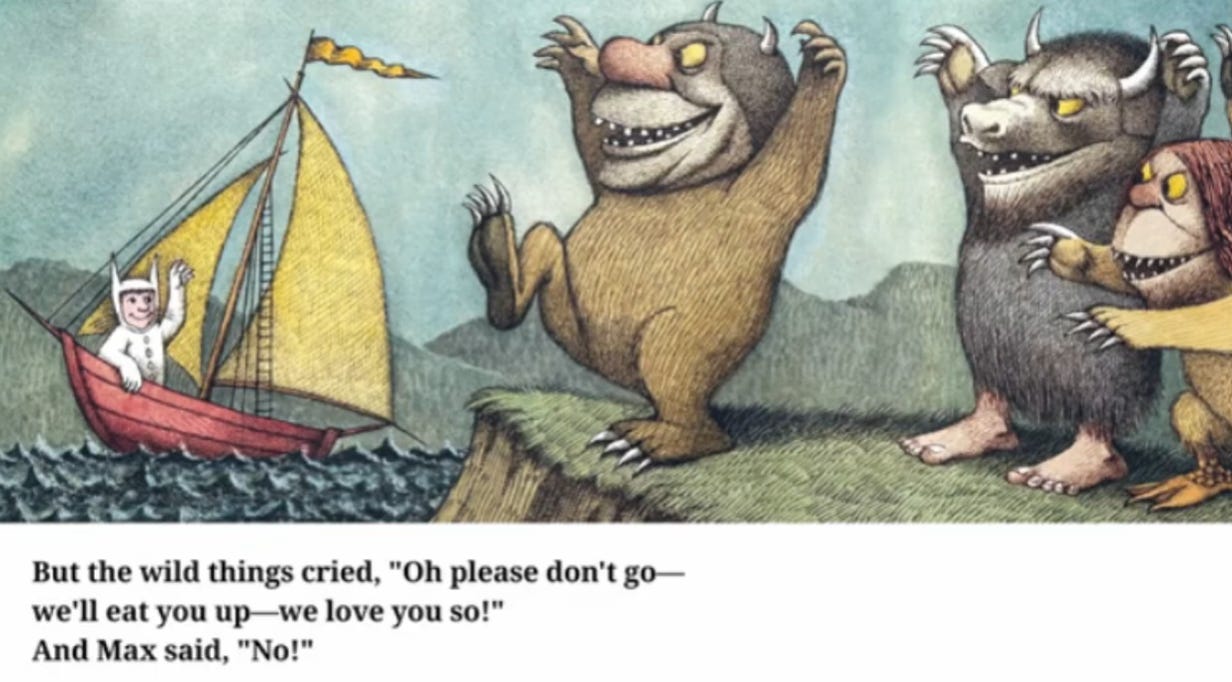
It is one of the strangest declarations of love in children’s literature. They cannot bear the distance between themselves and Max, so they dream of abolishing it entirely. Their love is possessive. To love Max is to keep him. To consume him. To make sure he never leaves.
Jean-Paul Sartre thought love often falls into precisely this trap. We don’t simply want another person to love us; we want to possess their freedom. We want them to choose us forever, while remaining free enough that the choice still means something. It is an impossible contradiction. The more we try to possess another person, the less free their love becomes.
Simone de Beauvoir argued genuine love could never require the destruction of the beloved’s freedom. To love someone is not to absorb them into your own life until nothing remains of them. It is to will their freedom alongside your own. The greatest relationships are not those in which two people disappear into one another, but those in which each helps the other become more fully themselves.
As Skye Cleary says:
A key theme of authentic love is resistance between, but welcoming of, two independent consciousness acting like positive and negative magnets within a single magnetic field.
I think this existentialist understanding of love is one that is not as scary and unrealistic as the love of becoming one thing not two. It is not healthy to lose yourself in someone else.
Max leaves the wild things, even though they love him so. He returns home to where he is loved best. And that is an interesting phrase to me as well. What does it mean to be loved best?
When Max returns home he finds that supper is waiting for him, and it is still hot. But he still faces the consequences. He isn’t invited to join his family at the table. He had been a wild thing and he has not been greeted home with open arms as if he did nothing wrong and all has been forgotten.
But supper is waiting for him and it is still hot.
And that is the kind of love that is best. It is not the consumption of the wild things. It is not the destructive volcano.
It is a love that leaves space for Max to return home from being a wild thing and to know he is still loved even though he is not perfect. His mother does not want to consume or destroy Max. She wants him to remain himself and to choose to come back from the wild things, and to, hopefully, stay this time.
I don’t know whether life always offers us endings like Maurice Sendak’s. Perhaps there are times when we have sailed too far and for too long, despite making a promise to return, but the existentialist within me and the romantic within me hopes that when it is true love, it is also the best love and there will always be a way to come home.
Max misbehaved and he went to where he thought he could find the best kind of love, but it was not a healthy love. It was a love that would have consumed him if he had stayed. He would have literally become a wild thing.
But his mother’s love was different and it was best.. She did not consume him . Max was still himself when he returned. What she offered was the kind of love that accepts and allows Max a freedom that he would not have had with the wild things. She offered a love that allowed him to return to himself. She offered him supper. And it was still hot.
1 I actually think this is a misreading of the passage and that the trees still stay as two trees, it’s just that when you love someone your lives become entangled. But when I had it at my wedding I thought it was more about becoming one soul.
If this essay sparked your thoughts and you'd like to explore the ideas I've written about, you're welcome to use the affiliate links below. They cost you nothing extra, but they help keep the books, the ink, and the coffee flowing.
Where the Wild Things Are — Maurice Sendak
Existentialism and Romantic Love — Skye Cleary
If you enjoyed this essay and know someone who overthinks and whose margins are filled with glosses, consider sharing it with them.